
Malang Candi Collection
Item set
Items
1–4 of 4
Advanced search
-
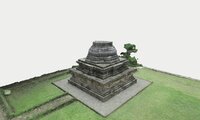 3D Model of Sumberawan Temple (Candi Sumberawan) Candi Sumberawan is an ancient Buddhist monument located in Toyomarto village within the Singosari district of Malang Regency, East Java. Nestled in a lush pine forest at the foothills of Mount Arjuno, the site is situated at an elevation of about 650 meters above sea level. It sits adjacent to a natural, crystal-clear water spring—which gives the site its name, as "sumber" translates to spring or source in Javanese—creating a highly tranquil and picturesque environment. Historically, the site is believed to date back to the late 14th century, bridging the late Singhasari and Majapahit periods. It is widely identified with "Kasurangganan," a sacred place mentioned in the famous old Javanese eulogy, the *Nagarakretagama*. According to the text, the site was renowned as "the garden of the heavenly nymphs" and was specifically visited by King Hayam Wuruk of the Majapahit Empire in 1359 during his royal tour across East Java. Architecturally, Candi Sumberawan stands out as a unique anomaly among East Javanese antiquities, as it is the only known temple in the region built entirely in the shape of a Buddhist stupa. Constructed from andesite stone, the monument features a plain square base that transitions into an octagonal midsection, which then supports a smooth, bell-shaped dome (*anda*). The very top pinnacle of the stupa is missing, having likely eroded or fallen over time. Notably, the structure lacks the stairs, entrance portals, or inner chambers typically found in other Javanese *candi*, indicating a purely symbolic external structure. Because it possesses no inner room for statues or offerings, the monument was not designed for interior worship. Instead, it was likely utilized for the Buddhist ritual of *pradakshina*, where devotees would walk clockwise around the structure in moving meditation. Combined with its proximity to the life-giving spring, Candi Sumberawan served as a vital sanctuary for asceticism, purification rituals, and the veneration of water, maintaining its aura of spiritual serenity to this day.
 -
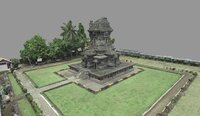 3D Model of Singhasari Temple (Candi Singosari) Candi Singosari (or Singhasari Temple) is a 13th-century monument blending Hindu and Buddhist traditions located in Candirenggo village in the Malang Regency of East Java. It sits in a valley at 512 meters above sea level, facing Mount Arjuno, and is believed to mark the historic heart of the ancient Singhasari Kingdom. The temple was built as a memorial shrine (pendharmaan) for King Kertanagara, the last monarch of the Singhasari empire, who died at the hands of Jayakatwang in 1292. Documented in the Nagarakretagama manuscript and a 1351 inscription found on-site, the monument honors the king by seamlessly merging his devoted Shaivite and Buddhist beliefs. Made of andesite stone, the temple's architecture breaks from traditional Javanese designs. Its main chambers and statues are built into the foundation (kaki candi) rather than the central body. The middle section remains intentionally empty to represent Parama Sunya, or the ultimate void in Buddhist philosophy. Additionally, the plain, uncarved Kala heads over the lower doors suggest the structure was never fully completed. The site is also famous for its impressive stone sculptures. The base once held beautifully detailed figures of Shiva (as Agastya), Durga, and Ganesha—the latter having been taken to Thailand in 1896 by King Chulalongkorn. Nearby, two massive stone guardians, known as Dvarapalas, stand watch, having originally been carved to protect the royal tombs and the entrance to Kertanagara's palace. 3D model constructed by drone + handheld photogrammetry.
 -
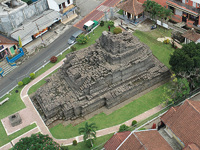 3D Model of Jago Temple (Candi Jago) Candi Jago, located in Tumpang, Malang, East Java, is a 13th-century Hindu-Buddhist temple of the Singhasari Kingdom, believed to be a memorial for King Wisnuwardhana (c. 1268-1280 CE). The name derives from Old Javanese 'Jajaghu' (glorious). Its terraced stepped-pyramid structure bears bas-reliefs of the Mahabharata, Ramayana and Buddhist Jataka tales. 3D model constructed by drone + handheld photogrammetry (476 images; Meshroom/Metashape).
 -
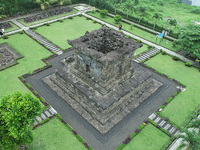 3D Model of Badut Temple (Candi Badut) Candi Badut is a small yet historically significant Hindu temple in Malang, East Java, believed to have been built in the 8th century (c. AD 760) during the Kanjuruhan Kingdom — one of the oldest temples in East Java. Its central chamber once housed a Lingga-Yoni symbolizing the worship of Shiva. The remaining carvings reflect early Javanese stone construction. 3D model constructed by drone + handheld photogrammetry (460 images; Meshroom/Metashape).
1–4 of 4